Launching Filo's US Tutoring Marketplace
Launched Personalized Instant Tutoring Platform
Zero to $1.5M ARR in six months, starting with three weeks spent arguing against the faster path.
Founding US Product Manager - owned US matching layer, activation funnel, session experience, trust and safety
Worked with engineering, data science, design, and a 200-person ops team
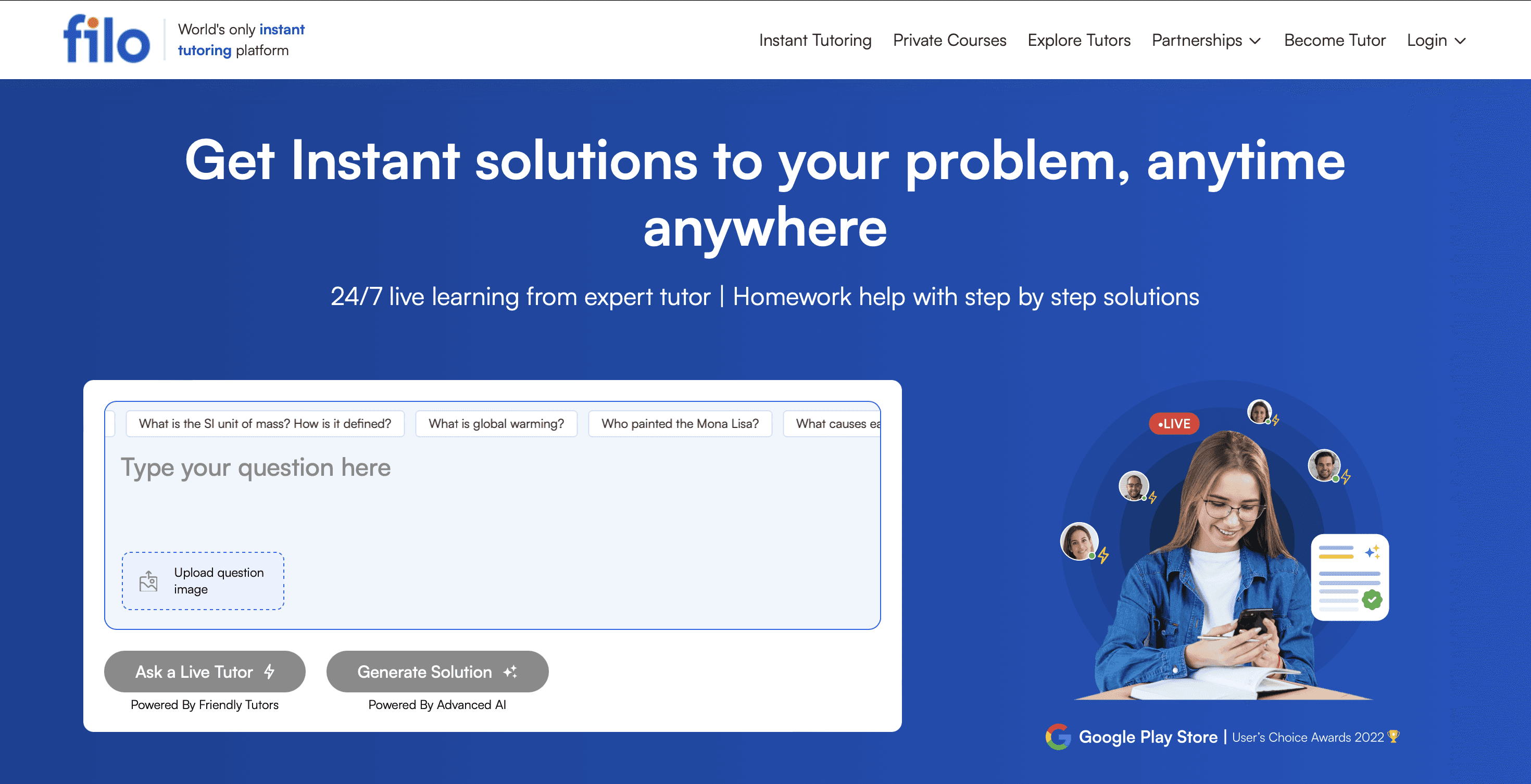
I spearheaded the launch of a personalized instant tutoring platform in the US market, scaling it from concept to 120K+ users in six months. Through deep market research, UX optimizations, and targeted growth strategies, the product became a trusted solution for students seeking on-demand learning support.
The Setup
The hardest part of launching into a new market on a proven platform is that the proof works against you.
Filo's instant tutoring marketplace was already serving 2M+ users in India when we started in the US. The matching engine worked. The rational move was to point the existing system at a new geography, ship, and optimize over time. That was what the organization wanted, and the argument for it was strong: the logic was built, tested, and running at scale.
The complication was that instant tutoring is a real-time marketplace, which makes it a harder liquidity problem than it looks. A student stuck at 9PM does not want a session on Thursday. That single constraint removes every tool a marketplace normally uses to hide thin supply. No queuing, no scheduling, no notify-me. Either a qualified tutor connects within seconds or the demand is gone permanently.
India absorbed that constraint on abundance. Years of accumulated tutor density meant the matching engine had never once had to work thin. We were launching from zero, against a 60-second target set by a platform that had never faced the problem we were about to have.
The hardest part of launching into a new market on a proven platform is that the proof works against you.
Filo's instant tutoring marketplace was already serving 2M+ users in India when we started in the US. The matching engine worked. The rational move was to point the existing system at a new geography, ship, and optimize over time. That was what the organization wanted, and the argument for it was strong: the logic was built, tested, and running at scale.
The complication was that instant tutoring is a real-time marketplace, which makes it a harder liquidity problem than it looks. A student stuck at 9PM does not want a session on Thursday. That single constraint removes every tool a marketplace normally uses to hide thin supply. No queuing, no scheduling, no notify-me. Either a qualified tutor connects within seconds or the demand is gone permanently.
India absorbed that constraint on abundance. Years of accumulated tutor density meant the matching engine had never once had to work thin. We were launching from zero, against a 60-second target set by a platform that had never faced the problem we were about to have.
The Decision
I did not think the logic would transfer, and I could not prove it yet.
The behavioral difference was the real issue. US students were not Indian students in a different time zone. They approached sessions differently and wanted a more collaborative learning experience, which changed how much session intent should weigh in what counted as a good match. Matching tuned for dense supply also optimizes for the best available tutor, when the actual job in a thin market is finding an acceptable tutor fast enough that the student stays.
Every one of those claims was a hypothesis. The organization was not going to delay a launch on a hypothesis. So I asked for three weeks to prove it, and got them.
What came out of that window was a US-specific matching design built around five things that behaved differently here: tutor liquidity, subject, pricing dynamics, geography, and session intent.
Within six months of launch, the platform scaled to over 120K users, achieving 120% Q-o-Q growth while maintaining strong engagement metrics. The attribute-driven matching model significantly improved tutor-student compatibility, leading to higher satisfaction and repeat session bookings. By collaborating closely with marketing, we acquired high-LTV user cohorts that boosted retention and monetization potential, rather than attracting low-value free trial users. These efforts not only enhanced activation rates by 30% but also established the platform as both instant and intelligently personalized, carving out a differentiated position in the competitive US edtech market.
What It Cost
Three weeks out of a six-month launch window is not free, and I have never pretended it was.
We spent them proving something rather than building it, on a lean team, at a pace that held only because the window was short. Had the hypothesis been wrong, I would have burned a fifth of the runway to arrive at the answer everyone else already wanted, with less time left to execute it.
I would make the same call again, but the honest version of this story is not that I saw something others missed. It is that I was confident enough to spend scarce time proving it, and the cost of being wrong was real.
Within six months of launch, the platform scaled to over 120K users, achieving 120% Q-o-Q growth while maintaining strong engagement metrics. The attribute-driven matching model significantly improved tutor-student compatibility, leading to higher satisfaction and repeat session bookings. By collaborating closely with marketing, we acquired high-LTV user cohorts that boosted retention and monetization potential, rather than attracting low-value free trial users. These efforts not only enhanced activation rates by 30% but also established the platform as both instant and intelligently personalized, carving out a differentiated position in the competitive US edtech market.
What Shipped
The Matching Layer - US-specific matching across tutor liquidity, subject, pricing dynamics, geography, and session intent, holding 98% of requests under a 60-second target
The Activation Funnel - 100+ user interviews and cohort analysis to locate pre-first-session drop-off, then onboarding and session-continuity improvements shipped with design and engineering
The Session Itself - OCR intake so a student could photograph a problem instead of typing it, low-bandwidth audio and video for unreliable connections, and tutor quality thresholds.
The Matching Layer - US-specific matching across tutor liquidity, subject, pricing dynamics, geography, and session intent, holding 98% of requests under a 60-second target
The Activation Funnel - 100+ user interviews and cohort analysis to locate pre-first-session drop-off, then onboarding and session-continuity improvements shipped with design and engineering
The Session Itself - OCR intake so a student could photograph a problem instead of typing it, low-bandwidth audio and video for unreliable connections, and tutor quality thresholds.
Outcomes
$1.5M+
ARR in 6 Months
98%
Matched Under 45 Seconds
+35%
Activation Lift
The US marketplace went from zero to 120K users in six months, and the matching layer is what made the instant promise real rather than aspirational.
Growth came from fixing the funnel rather than buying volume. Conversion reached 3%+.
The US marketplace went from zero to 120K users in six months, and the matching layer is what made the instant promise real rather than aspirational.
Growth came from fixing the funnel rather than buying volume. Conversion reached 3%+.
What I Know Now
The most expensive assumption in product is that a working solution transfers. Marketplaces look identical across geographies and the parameters underneath them are entirely different, which is exactly what makes reuse so tempting and so costly.
The part I underrated at the time was that being right is not the job. Being right early enough, with enough evidence, that an organization under launch pressure will act on it, is the job.
The most expensive assumption in product is that a working solution transfers. Marketplaces look identical across geographies and the parameters underneath them are entirely different, which is exactly what makes reuse so tempting and so costly.
The part I underrated at the time was that being right is not the job. Being right early enough, with enough evidence, that an organization under launch pressure will act on it, is the job.